
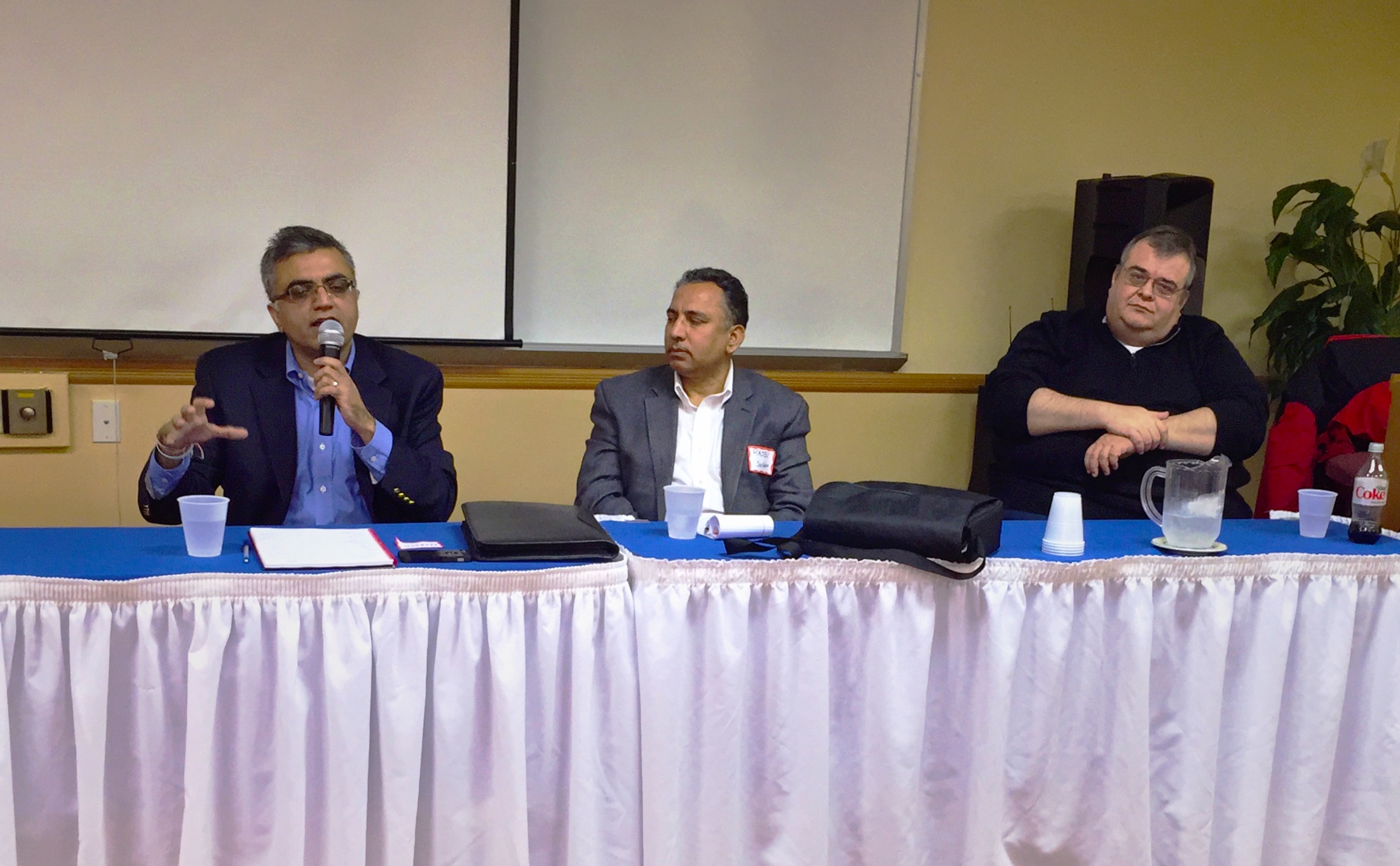
March Meeting: Discussion Panel: “Digital Disruption – Part 1”, moderated by George Pace.

tbc20150314panel2

The Breakfast Club NJ Presents a Discussion Panel: “Digital Disruption – Part 1”, moderated by George Pace.

Saturday March 14th at 8:00am ET

Synopsis:

Please share this with other groups you may be in. Join us on Meetup.com at: http://www.meetup.com/The-Breakfast-Club-NJ/ to RSVP for the meeting.
Slight venue change – March 14 ONLY – we are meeting in the Middlesex room (changed 3/12/2015)

“Discussion Panel – Digital Disruption – Part 1”
Defined as “the change that occurs when new digital technologies and business models affect the value proposition of existing goods and services”, Digital technologies such as Social Media, Big Data, Cloud and Mobile are not only disrupting business models – but the job market as well.
As Digital is such a large (and at times complex) space, this month the Breakfast Club is proud to introduce a Panel Format that will walk the audience thru various aspects of Digital Disruption which include:

  • Defining Digital Disruption in today’s environment
  • Examples of where Digital has had an impact
  • New career opportunities – and careers that maybe threatened/impacted
  • What trends / direction should job seekers expect in the next 1-2 years
  • Suggested skill sets individuals should start focusing on

The panel will consist of the following Breakfast Club members who are involved with various aspects of Digital:
Our Moderator: George Pace, George is a Director – IT Infrastructure and Enterprise Architect at Prudential Financial Services where he is currently focusing on Cloud and DevOps Architecture. In his spare time helps people leverage the power of Social Media.

About the panelists:

Frank Kovacs – The BreakfastClub Founder and Global Head, Digital Business at Sutherland Global

Haresh Keswani – Haresh is a business technology professional focused on Digital Transformation in Healthcare and Life Sciences segment. He has had consulting opportunities to work at big pharma like GSK, Johnson and Johnson, and Novartis wherein he has lead multitude of Digital Projects in areas of Commercial Operations – Sales and Marketing. At Pfizer he was one of Director’s responsible for Digital landscape globally from business case to execution. He has also implemented 360 View of Customer for GE with basic channels like email, chat, web, and customer service center a decade back.

Rajeev Sachdeva – Information Technology executive with extensive strategy, execution and technology delivery experience in the Group Insurance and Financial Service space. Worked at marquee names like Lincoln Financial, Prudential, Morgan Stanley and Tata Consultancy Services.

And to compliment this discussion – April’s The BreakfastClub NJ presentation will be entitled “Digital Disruption – Your Career Curriculum”

TBC meetings for 2015 are free (courtesy of one of our members), and free breakfast (bagels) to the first 50 attendees!!!

Be sure to tell your friends and bring them along. Be a part of our growing network of Job Seekers, Hiring Managers, Recruiters, Career Coaches, and people who want to be able to help themselves and each other.

Event Location:

Days Hotel Conference Center
195 Rt. 18 South, East Brunswick, NJ 08816
732-828-6900

Meeting Format:

7:30 to 8:00 – Registration & Open Networking

8:00 to 8:15 – Welcome and housekeeping

8:15 to 9:15 – Presentation by the guest speaker – Limited to 60 minutes

9:15 to 10:15 – Elevator Pitch – 30 Seconds about yourself, who you are, what you are looking for, target companies (3-4), how we can help you, how you can help others. Follow the rule of the Three B’s of Public Speaking: Be informative; Be brief; Be seated.

10:15 until you choose to leave – Open Networking, follow up with people you are interested in meeting following their elevator pitch, exchange business cards, peruse the library, arrange follow up meetings, etc.

The Breakfast Club NJ – 10 Points for Good Member Citizenship

  1. Attend meetings regularly to keep group strong and help pay back to others (meeting logistics on our website www.thebreakfastclubnj.com)
  2. Keep anti-virus on your machine up to date and run scan regularly
  3. Review messages and if request for assistance please help whenever possible
  4. Join linked in group and connect to other members directly (questions see Gerry Peyton)
  5. Join Facebook and Google+ groups and connect to other members directly (questions see Adrienne Roman)
  6. Follow twitter account (questions see George Pace)
  7. If you run across someone in transition invite them to join our group and sponsor them through process (details on our website www.thebreakfastclubnj.com)
  8. Sunday mornings listen to our radio show, “Your Career Is Calling”, at 8am ET either on radio at 107.7 or via internet 24/7 live or on demand at www.1077thebronc.com (as this is a call in show your calls help make it successful)
  9. If you are in transition put your elevator pitch in writing to group, ask for help with job search issues or connecting to people at target companies, regularly post job opportunities (from email you joined the group – send email to thebreakfastclubnj@yahoogroups.com)
  10. Help fellow members whenever possible

We look forward to seeing everyone let’s make this a great meeting for our members that are in transition and welcome those that have landed


Posted in Monthly Meeting Tagged with: , , , , , , , , , , , , , , , , , , , , , , , ,

Strategically Aligned Projects or Tech Projects: Which is More Exciting?

Sometimes, a Project Manager (PM) gets an opportunity to work on a new technology project, while other times it may be a project that has a straight line to a strategic initiative in the organization. Most times, there will not be a choice; the PM either works on technology projects or the PM works on strategically aligned projects. However, if a PM is torn between which of the two the PM should work on, a dilemma may present itself. Traditionally, when a PM works in an organization, there is an assumption that the PM would be working on technology projects. However, it should be noted that the Project Management Institute (PMI) began with mostly construction or engineering PMs, not technology PMs. So, there is no reason why a PM cannot handle a strategically aligned project. That said, which type of project would a PM be more comfortable with? Or a better question, which is more exciting for a PM to work on?

Technology vs. Strategic

Sometimes we do not see the forest for the trees. What I mean by that is the fact that a technology project can be a strategically aligned project. I have stated this in previous blogs and I will say it again: if the project cannot be traced to a organizational strategy, then you are not working on a project, that even when completed successfully, will have an impact on the organization. We PMs who work in technology get mired in the weeds and sometimes have a professional convulsion if our project  not a technology project, especially a new technology project. We PMs have to move beyond our belief systems regarding project management and think like executive management.  Maybe not so much like the CEO or President of the organization. However thinking like that would benefit us. Why not like the COO or the CFO? With security strikes like the hacking of Target, we definitely should be thinking like the CSO for our projects. If we cross that gap, we then can, as they say, think outside the box, and think like leaders, not just managers. Thinking strategically, whether we are on a technology project or not, means that we have to go beyond the “four walls” of our comfort zone, and begin thinking like the leaders and managers of the organization. This can be scary because we may see that the project we are working on does not fit the strategic future of the organization. That is a risk we all must take.

Which Project Provides Greater Visibility?

The answer is both, depending on the strategic importance of the project.  If we take a good hard look at the direction of our organization and read the organizational philosophy, as well as any related strategic statements, then we will see whether we are working on projects that align with those philosophies. I know that most of us PMs are over-worked as it is now. I know that we are “doing more with less.” I get all of that. However, if we PMs truly want to stay in the organization we are currently in, then we have to make the time to do that research. By the way, doing that research would not take a great deal of effort. I know that it may impact personal time, which we already have less of. But the fact remains that it is up to us to make that effort.

Should a PM Try To Point His/Her Career Towards One Type Of Project?

Yes. However, you have to sell to senior management that you can take on one of these projects and complete it successfully. That may take some time, but you will have to chart a course that reflects that. We all believe we can be the best PM on any project we start. We have to convey that confidence with visible results to senior management. If we just drop our chins and believe that we do not get the best pick of the projects because the odds are stacked against us, then we will convey an aura of defeatism that will be picked up by senior management and they will not award you with one of these projects.  A colleague of mine told me that you must always be positive,a although even when it is very difficult to be positive. I am asking you to do so and convey that positive aura about yourself.

In conclusion, strategic and technical projects should not be separated because of any pre-conceived notions. These projects can and should be strategic and aligned with the corporate philosophy. And yours should be too.

I am open to discussion at any time on these blogs or anything else related to project management you would like to explore. If you would like to comment about this blog, please do so by posting on this blog or by responding in an email at Benny A. Recine. You may inspire a blog article. I look forward to your comments.

from BCNJ Member Blog Feed http://dlvr.it/8mGnQp
via IFTTT

Posted in Member Contributions Tagged with: ,

Using the Cloud for Data Backups

There are two kinds of organizations in the world: Those that have lost critical data, and those that will. If you use technology long enough and neglect to back up your data, a single unfortunate incident can destroy your data and negatively impact your business. The solution is to back up everything that is important. Using an external hard drive or tape system can be an inconvenient or time-consuming task. That’s why more organizations are turning to managed cloud services for data backup.

The reason you want to think about the cloud for your backup storage is because it offers tremendous protection and availability to protect your data. One of the biggest benefits of protecting data in the cloud is that the cloud is not in your own data center. It doesn’t take the resources of your data center. If something were to happen in your data center, you would still be able to fall back to this external resource.
Another advantage to backing up your data to the cloud is that, with a proper service level agreement, you’ll have an actively managed, proven technology and expertise supported by your service provider. In addition to your in-house IT resources, which may be limited, you will have access to your service provider’s professional resources should you need to recover your data.
Additional advantages of a cloud-based backup solution, which you may need to request and verify that your storage service provider offers, are:
  • Backups of backups: Your data is always stored off-site and is redundantly copied to other servers in different locations. If one location becomes unavailable, your data can be backed up or retrieved from elsewhere on the backup network without a service interruption.
  • Security: Data is encrypted by the backup service provider’s software program from your computer or network before it is sent to the cloud, so thieves on the internet cannot access it.
  • Virus protection: The backup service software detects any virus or infection before data is sent. If a virus is found, that file is not copied to the backup service. You will be notified that the corrupted file has not been deleted from your computer. In this case, you won’t lose any data, but that data won’t be backed up online.
There are some caveats about using cloud based backup solutions. While these can often be mitigated via your backup and recovery strategies, you need to be aware they exist:
  • Cost: While usually less costly from a capital expense perspective, a cloud-based backup solution can be more expensive from an operating expense perspective as compared to on-site backups . Typically, you will pay a monthly or annual subscription based on the amount of data stored on the service provider’s servers as well as for their professional services.
  • Perform a business risk assessment. Also, do a cost-benefit analysis of your backup storage options. You may see that the risk mitigation benefit will exceed the cost.
  • Capacity: Cloud-based backups may not be best for large backups such as a large number of files, or very large files such as data bases. Since some internet providers limit the amount of data you can send and receive in a month. You may need to avoid large backups that cause you to exceed their stop-limits or trigger over-utilization charges.
  • Perform incremental backups. That is, instead of sending all of your data to the backup site on a scheduled basis. Send all of your data only once when you implement your solution. Then, only send the changes to the data on a scheduled basis. Make sure that your service provider can properly archive incremental changes, and restore your data at any point of time. While you typically do not have a need to recover large blocks of data, have a recovery strategy in place for when you need to do so.
  • Speed: It can take a long time to back up large backups online, even with a broadband connection.
    • The same Mitigation for “Capacity” applies here
      Considering your resources with the consequences of hardware malfunctions, human errors, software corruption and man-made or natural disasters can keep you from focusing on your many strategic initiatives. With a cloud data backup solution, you can gain the peace of mind that your data are protected and available for recovery when the time comes.


      I encourage you to leave a comment by clicking on “…comments” below…
      David Schuchman

      from BCNJ Member Blog Feed http://dlvr.it/8ZhsXd
      via IFTTT

      Posted in Member Contributions Tagged with: ,

      Are you just looking for a job, or do you have a campaign going?

      No one needs to reiterate that today’s is a difficult job market that is unprecedented in recent times or that regrettably, many people are looking for jobs for extended amounts of time—sometimes for years! As a career coach, I often work with such people, and I notice that they have things in common: None of […]

      The post Are you just looking for a job, or do you have a campaign going? appeared first on Landing Expert Career Coaching.

      from BCNJ Member Blog Feed http://dlvr.it/8RhFfx
      via IFTTT

      Posted in Member Contributions Tagged with: ,

      Monthly Meeting

      The Breakfast Club NJ Presents: “A Workshop – Let’s Improve Your Elevator Pitch” by Alex Freund

      Saturday February 14th at 8:00am ET

      aboutAlex

      Synopsis:

      Please share this with other groups you may be in. Join us on Meetup.com at: http://www.meetup.com/The-Breakfast-Club-NJ/ to RSVP for the meeting.
      The Workshop: “Let’s Improve Your Elevator Pitch”
      The workshop will start with information about the important elements of an effective elevator pitch. Then it will offer general guidelines covering content, tone of voice, body language, and facial expression; and it will give examples. During the second half of the workshop, we will work together on the elevator pitches of audience volunteers.

      About the speaker:

      About the speaker:
      Alex Freund, the “landing expert,” supports job seekers into employment. He is known for making people feel comfortable when interviewing. Alex is an effective and successful career and interviewing coach. He is prominent in several on- and off-line job-search networking groups, conducts workshops on effective resume development and use of LinkedIn in the job-search process. Alex has been teaching for several years a career development seminar, and publishes a blog designed especially for job seekers. Prior to his current position, Alex managed several large departments in two Fortune 100 companies. Alex maintains and publishes a free directory of job-search networking groups via his web site at http://www.landingexpert.com
      Alex is a Cornell University grad, lived on three continents and speaks five languages.

      Meeting Information:

      Networking begins at 7:30 am, meeting starts promptly at 8:00 am.

      TBC meetings for 2015 are free (courtesy of one of our members), and free breakfast (bagels) to the first 50 attendees!!!

      Be sure to tell your friends and bring them along. Be a part of our growing network of Job Seekers, Hiring Managers, Recruiters, Career Coaches, and people who want to be able to help themselves and each other.

      Event Location:

      Days Hotel Conference Center
      195 Rt. 18 South, East Brunswick, NJ 08816
      732-828-6900

      Meeting Format:

      7:30 to 8:00 – Registration & Open Networking

      8:00 to 8:15 – Welcome and housekeeping

      8:15 to 9:15 – Presentation by the guest speaker – Limited to 60 minutes

      9:15 to 10:15 – Elevator Pitch – 30 Seconds about yourself, who you are, what you are looking for, target companies (3-4), how we can help you, how you can help others. Follow the rule of the Three B’s of Public Speaking: Be informative; Be brief; Be seated.

      10:15 until you choose to leave – Open Networking, follow up with people you are interested in meeting following their elevator pitch, exchange business cards, peruse the library, arrange follow up meetings, etc.

      The Breakfast Club NJ – 10 Points for Good Member Citizenship

      1. Attend meetings regularly to keep group strong and help pay back to others (meeting logistics on our website www.thebreakfastclubnj.com)
      2. Keep anti-virus on your machine up to date and run scan regularly
      3. Review messages and if request for assistance please help whenever possible
      4. Join linked in group and connect to other members directly (questions see Gerry Peyton)
      5. Join Facebook group and connect to other members directly (questions see Adrienne Roman)
      6. Follow twitter account (questions see George Pace)
      7. If you run across someone in transition invite them to join our group and sponsor them through process (details on our website www.thebreakfastclubnj.com)
      8. Sunday mornings listen to our radio show, “Your Career Is Calling”, at 8am ET either on radio at 107.7 or via internet 24/7 live or on demand at www.1077thebronc.com (as this is a call in show your calls help make it successful)
      9. If you are in transition put your elevator pitch in writing to group, ask for help with job search issues or connecting to people at target companies, regularly post job opportunities (from email you joined the group – send email to thebreakfastclubnj@yahoogroups.com)
      10. Help fellow members whenever possible

      We look forward to seeing everyone let’s make this a great meeting for our members that are in transition and welcome those that have landed

      Posted in Monthly Meeting Tagged with: ,

      The Elevator Pitch Checklist

      A recent article of mine covered most people’s lack of efficacy in practicing their elevator pitches at job search networking meetings. I wanted to follow up on that and prove my tenets, so I brainstormed with a group of trusted associates—all of whom are in transition—and we came up with some “best practices.” Following are […]

      The post The Elevator Pitch Checklist appeared first on Landing Expert Career Coaching.

      from BCNJ Member Blog Feed http://dlvr.it/8Lc7Xk
      via IFTTT

      Posted in Member Contributions Tagged with: ,

      Don’t Just Prioritize Tasks, Say No to Some

      Good time and project management doesn’t necessarily mean doing everything requested. More importantly, it means doing what is best for your organization, even when the organization may not realize it. Success and achievement are not measured by doing everything requested of you. It’s measure by doing the right things. Sometimes to improve productivity and be successful, you must say no to some tasks, or at least defer some.

      Set Goals
      Understand what you must accomplish and when it’s actually needed. Goals give you a destination and vision to work toward. When you know where you want to go, you can manage your priorities, time, and resources to get there. Goals also help you decide what’s worth spending your time on, what’s not an immediate priority, and identify what’s just a distraction.
      Prioritize Tasks
      One of the biggest work challenges that many people face is accurately prioritizing their workload. Here are some guidelines to prioritizing your task list to keep you well-organized:
      • Collect a list of all your tasks: Pull together every request made of you that you could possibly consider getting done. Don’t worry about the order, or the number of items up front.
      • Identify urgent vs. important: See if you have any tasks that need immediate attention – work that if not completed on time will have serious negative consequences. Those are important.
      • Assess task value: Look at your important work and identify what carries the highest value to your business and organization. For example, focus on client requests before internal work, organizational requirements before desired requests, and how many people are impacted by your work.
      • Check priority daily: Be flexible and adaptable. Know that your priorities will change and sometimes when you least expect them to. Keep focused and committed to the tasks you’re committed to doing right now.
      Be prepared to say “No”
      You may not be able to get to everything on your list. After you prioritize your tasks and add up the ranged estimates, cut the remaining tasks from your list. Focus on the priorities that you know you must and can complete. You can revisit the other tasks at a later time.
      You can apply the above strategy to large-scale projects as well as to your daily workload.


      I encourage you to leave a comment by clicking on “…comments” below…

      David Schuchman

      from BCNJ Member Blog Feed http://dlvr.it/8LGGCW
      via IFTTT

      Posted in Member Contributions Tagged with: ,

      Is the PMP as portable as PMI says it is?

      In my career, I have been most fortunate to work on a variety of projects mostly those that are Information Technology (IT) – or financial services-driven. The IT projects have involved mostly software delivery or implementation, but I also have had the opportunity to conduct projects in technology driven infrastructure, state government, and yes, even a few months in pharmaceuticals. So you can say that I have touched projects in a varied assortment of industries. Nevertheless, there are certain industries that require specific knowledge of the type of product or service being delivered by the project team.  This brings up the question: Is the PMP portable to different industries? For example, can a PM who has worked mostly in financial services work as a pharmaceutical PM? Can a PM who has worked in infrastructure work in government? Let’s examine some questions.

      Can the PM show that he/she understands the “lingo?”

      This is the first and most likely the hardest question. Just because a PM has worked on technology projects focused on software doesn’t mean that the PM is a “fit” in a pharmaceutical company if the project has to do with software. Let’s say a company is focused on civil engineering. Will a PM understand the needs of the project if the PM has been working in financial services? There may be some exceptions, but I am of the mind that trying to get this PM job may be a tough sell. Yes, I have heard of exceptions, for example, a PM with experience in the refrigeration industry landed a position in pharmaceuticals. In this case, the PM’s knowledge of refrigeration was beneficial because the pharmaceutical company’s product needs to be refrigerated. That was an easy cross-over in industries. But how many experiences like that have you heard of? You see, the PM must be able to speak to at least the high-level of the product being delivered so that the project team members will respect the PM.

      Has the PM worked on similar projects?

      Let’s go back to our PM who understands the working of software contracts. Can he/she work on a scientific software project in a pharmaceutical company or a clinical research organization (CRO)? If the PM understands the types of contracts and legal and scientific terms commonly used in the industry, then he or she may be able to make the cross over. Again, this may be the exception and not the rule. Scientists who work in CROs may need a PM that thoroughly understands their needs and understands the legal issues of deploying, maintaining, and upgrading software that these scientists use.

      Can the PM show his/her flexibility in abilities?

      Sure, most PMs I know are very flexible and have worked on a variety of projects, such as I have. It is good for the PM to have a broad knowledge of multiple industries, as long as the PM can be focused on one type. On the one hand, the PM doesn’t want to be “pigeon-holed” in a single area, but on the other, neither does the PM want to be considered a jack of all trades but a master of none. The PM wants to be portrayed as an expert in his/her field with a working knowledge of how projects
      work in other industries.

      However, the question of portability in other industries becomes quite difficult to explain. I have seen exceptions where a PM has left the industry they have been working in for some time and gone over to another industry. However, those have been the exception. The rule usually is that the PM stays within their industry and works to become the go-to PM in that industry. 

      I am open to discussion at any time on these blogs or anything else related to project management you would like to explore. If you would like to comment about this blog, please do so by posting on this blog or by responding in an email at Benny A. Recine. You may inspire a blog article. I look forward to your comments.

      from BCNJ Member Blog Feed http://dlvr.it/8Kmk7F
      via IFTTT

      Posted in Member Contributions Tagged with: ,

      Do You Know Whom to Network With?

      By far the most effective way of getting a new job is by networking. When making presentations to large groups, I often test that tenet, and invariably it proves to be true. Therefore, networking is how people in transition should spend most of their time. For many, though, networking is a challenging task because they […]

      The post Do You Know Whom to Network With? appeared first on Landing Expert Career Coaching.

      from BCNJ Member Blog Feed http://dlvr.it/8Cjtr8
      via IFTTT

      Posted in Member Contributions Tagged with: ,

      The Job Interview—Morphed into Something Else

      Not too long ago, much-respected blogger Tim Tyrell-Smith of Tim’s Strategy conducted a survey, clearly finding that interviewers’ number one concern is “fit with the company’s culture.” From other articles on that subject, too, it seems as if the old-fashioned “Tell me about yourself” and “What are your key accomplishments?” questions—even when answered well—are apparently […]

      The post The Job Interview—Morphed into Something Else appeared first on Landing Expert Career Coaching.

      from BCNJ Member Blog Feed http://dlvr.it/88Kn8c
      via IFTTT

      Posted in Member Contributions Tagged with: ,